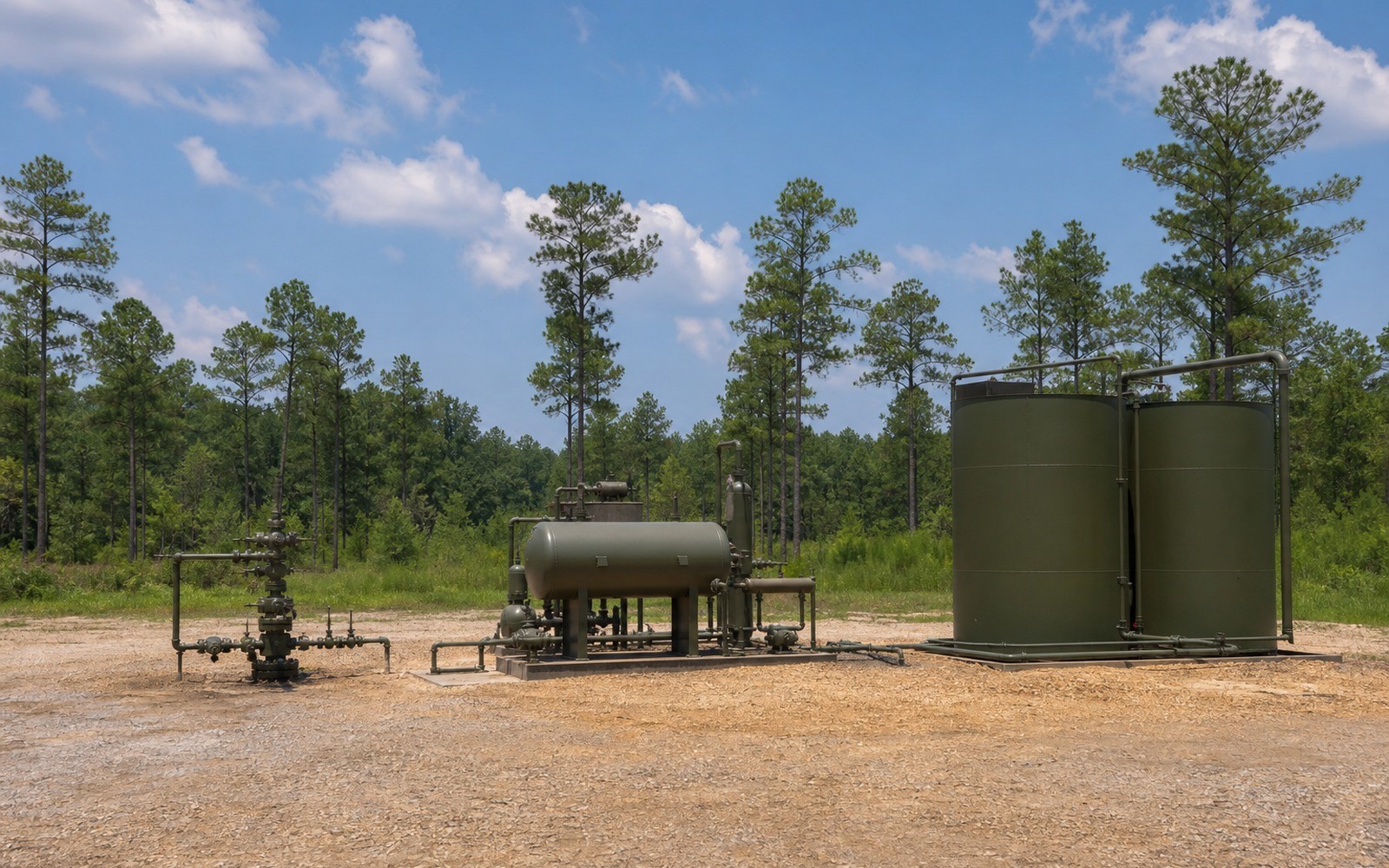
The Haynesville is an LNG play now, not a Henry Hub play. That distinction changes what your royalty is worth more than almost anything else you own.
The gas royalty desk has worked division orders on Haynesville and Bossier Shale acreage since before the Gulf Coast LNG terminals existed, and the play has changed twice in that time. First it was the original 2008-2012 land rush - tight spacing, high IP rates, operators like Chesapeake and Comstock racing to hold acreage by production. Then it went quiet when gas prices couldn't cover the drilling cost on a well this deep and this pressured. Now it's back, and the reason is Sabine Pass, Calcasieu Pass, Golden Pass and Plaquemines LNG pulling Gulf Coast gas out of the country entirely. Caddo, DeSoto, Bossier and Red River Parish on the Louisiana side, Panola, Harrison, Nacogdoches and San Augustine County on the Texas side - these counties sit closer to LNG feedgas pipelines than almost anywhere else producing gas in America, and that proximity shows up in your check.
It also means your interest doesn't price off a single national number. A Haynesville royalty owner selling today is really selling a basis position relative to the Gulf Coast, a decline curve that's steeper than most shale plays, and whatever pressure-related risk sits behind the current completion. The gas royalty desk walks sellers through all three before any number gets discussed.
Before the LNG terminals, Haynesville gas competed with Marcellus and Utica gas flooding into the same national pipeline grid, and it usually lost on price because it costs more to drill a well 11,000-13,000 feet deep under 9,000-plus psi than it does to drill a shallower Appalachian well. What the LNG terminals did was give Haynesville gas a shorter, cheaper path to a buyer who pays a different price entirely - the international LNG market. Feedgas contracts out of Sabine Pass and Calcasieu Pass draw heavily on Haynesville and Bossier production because the pipeline distance is short. That's basis differential in plain terms: the price your gas actually clears at, adjusted for where it sits relative to the buyer.
This is also why activity has concentrated in specific counties rather than spreading evenly across the play. DeSoto and Caddo Parish, and the Texas counties directly across the state line, sit in what operators call the core - thicker pay, better pressure, closer to takeaway capacity. If your minerals sit on the flank, in a county where permitting has slowed or gone quiet, that matters to any honest offer you get.
Haynesville wells produce under extreme pressure, which gives them strong initial rates but also a steep first-year decline - often 60 to 70 percent before the well settles into a longer, flatter tail. If you started receiving checks in the last twelve to eighteen months, you're likely watching that curve happen in real time: a big first or second check, then a noticeable step down every month after. That's not the operator shorting you. It's the physics of a Haynesville completion.
This is exactly why timing matters more here than in a slower-declining play like the Barnett. A buyer valuing PDP (producing) reserves on a Haynesville well has to weight the early months heavier than the tail, because the tail contributes less to total remaining value than it would on a flatter curve. If you're getting an offer, ask whether it's actually modeled on Haynesville-specific decline rates or a generic shale curve - the two produce different numbers.
The gas royalty desk won't quote a multiple here because it changes with the LNG contract schedule, the specific well's pressure and stage of decline, and whether there's PUD (undeveloped) potential still held by the lease. What the gas royalty desk can tell you is what drives the range: proximity to an active LNG feedgas corridor, whether your tract is held by production or sitting on expiring primary term, how many net mineral acres you actually hold versus what the deed says on its face, and whether there's a spacing unit already permitted that hasn't spudded yet.
Sellers who've had a Haynesville interest since the 2008-2012 land rush sometimes still think in terms of that era's lease bonus numbers. That market is gone. What's live today is a royalty and mineral acquisition market pricing off LNG-adjusted gas curves, not the bonus checks your grandfather or you cashed fifteen years ago.
Every Haynesville check stub carries deduction lines for gathering, compression and dehydration before the gas ever reaches a sales point, and because Haynesville wells produce at such high pressure, compression costs can run higher than a shallower well would show. If your lease has a market-enhancement or no-deduction clause, that protects you; if it's silent, the operator's deductions are probably legal even when they sting. we ask every seller for their last six months of check stubs before we put a number on the table, because the net-to-owner line tells us more than the gross production report does.
Louisiana and Texas also handle title differently at the courthouse - Louisiana runs on a civil-law system with usufruct and forced heirship issues that don't exist in Texas common law, so a DeSoto Parish tract with heirship complications takes a different closing path than a Panola County tract with clean title. Either way, we run it through the clerk of court or county clerk before we close.
It generally helps the basis, meaning Haynesville gas often clears closer to Gulf Coast pricing than gas from landlocked plays. It doesn't erase decline risk or drilling economics, so value still depends on where your specific tract sits and how far along the well is on its curve.
Probably not. Haynesville wells commonly lose 60 to 70 percent of their initial rate in the first year because of how much pressure drives early production. A steep drop that then flattens out is normal for this play, not a sign of an accounting problem.
Yes, but Louisiana succession and forced heirship take longer to clear than a straightforward Texas title, so expect a closing timeline measured in weeks rather than days. We work with a title attorney on any Louisiana parish tract before funds move.
Depends on whether there's undeveloped acreage or additional spacing units behind the producing well. If your tract has PUD potential from an unspudded unit, selling only the producing interest and keeping the rest is worth discussing before you sign anything away.
Different decline curves entirely. Haynesville front-loads value in the first 12-24 months; a mature Barnett well has already flattened and produces a longer, more predictable tail. We model each basin's actual production behavior rather than applying one multiple across every play.